Amazon Web Services 2022
One Time Media Handling
Streamlining secure media handling processes in data centers, reducing workflow complexity from 21 steps to 6 steps for improved technician efficiency and operational excellence.
The Problem
Why, what, and who
The existing media-destruction journey was manual, repetitive, and operationally
heavy. A technician could process around 6 media devices per day, with each one
requiring 21 steps, 24+ physical touches, and roughly 45 minutes to complete.
OTMH aimed to reduce that burden by automating identification, tracking, storage, and
custody — creating a process that was faster, safer, less error-prone, and
dramatically easier for technicians to complete.
One Touch Media Handling (OTMH) is a secure, automated media destruction experience designed for data centers. It transforms a 21-step, 24+ touchpoint process into a streamlined workflow where media is removed, identified, securely stored, tracked, and eventually destroyed with minimal human handling.
OTMH was designed primarily for data center technicians — the frontline operators
responsible for removing, identifying, tracking, and securely handling physical media
throughout its destruction lifecycle.
The experience was initially designed for deployment within a red-zone data center
environment in Dublin, where security and operational accuracy are critical.
Solution
Experience Walkthrough
0:00 / 0:00
Impact
Process Efficiency
Workflow steps reduced from 21 manual steps to 6 streamlined steps.
Human Touchpoints
Reduced repeated physical handling to a single-touch media journey.
Time Savings
Technician handling time per media reduced from about 45 minutes to under 5 minutes.
Daily Time Saved
With approximately 6 media handled daily, automation returned hours of technician time.
Manual Data Entry
Automated media identification and asset capture eliminated most repetitive input by 80%.
Chain of Custody
Media movement is fully tracked through automated identification and storage.
Behind The Scenes
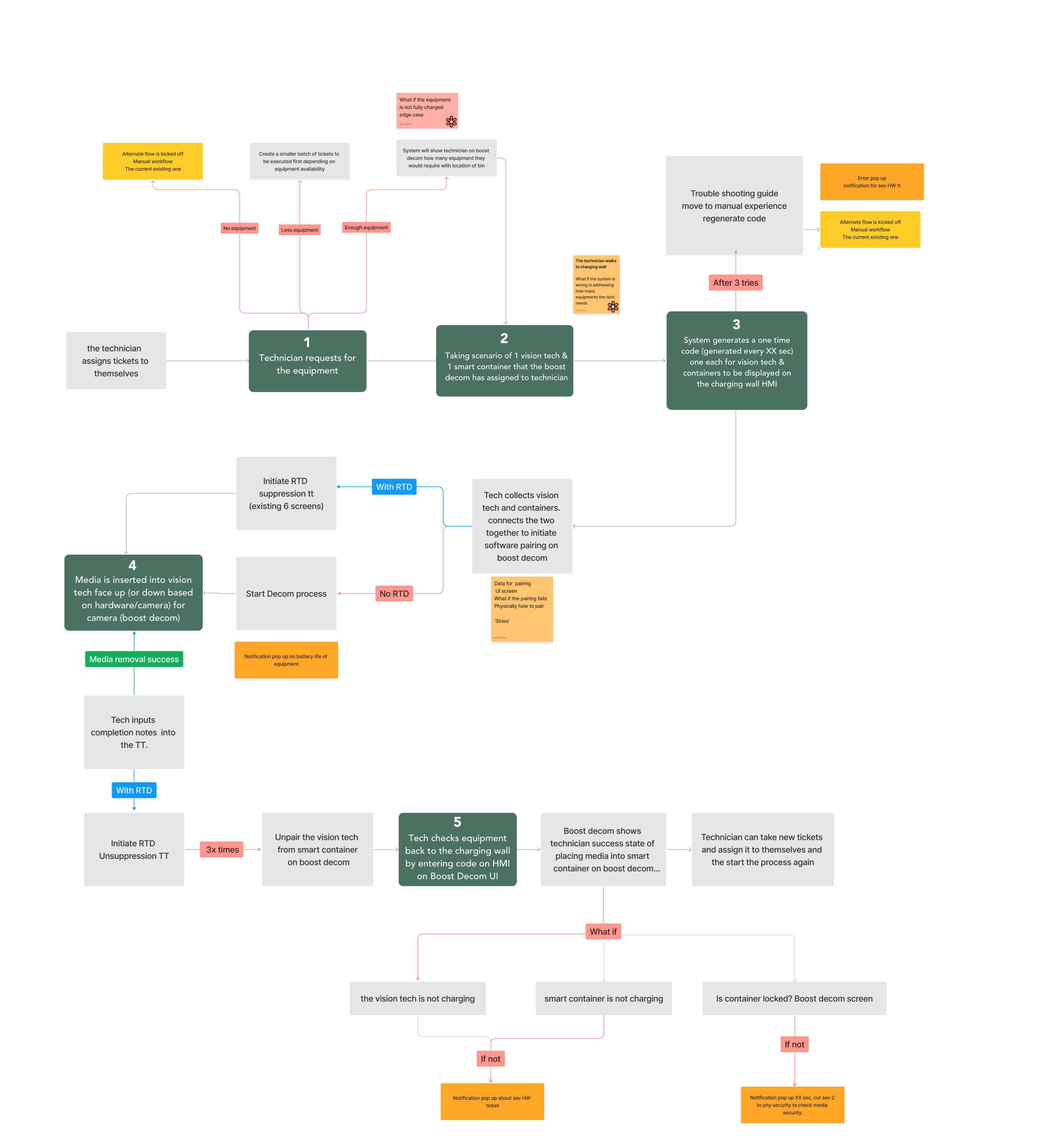
Mapped the technician journey to uncover pain points and identify design opportunities.